

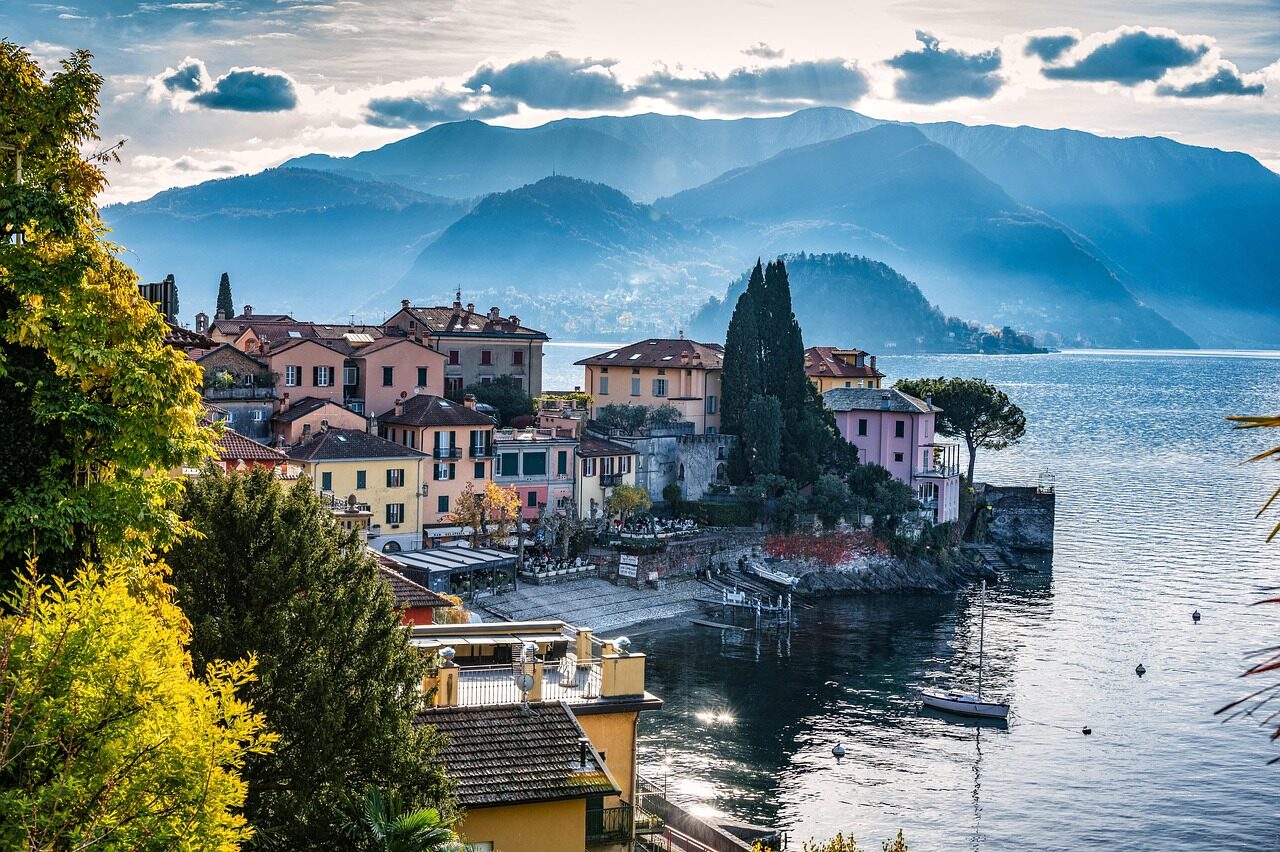
Both are beautiful Italian lakes with mountains behind them and pretty towns around the edge. They attract very different travellers, and the difference is not subtle once you know what to look for.
The short answer
Lake Como is smaller, steeper, more glamorous and more expensive. Villages cling to the shore beneath mountains, and it suits couples, short romantic trips and anyone who wants to look at something beautiful from a boat.
Lake Garda is much larger and more varied — the northern end is dramatic and mountainous, the south is flat, gentle and family-oriented. It has beaches, a theme park, better swimming and lower prices.
Getting there
Como is closer to Milan — around 40 minutes by train from Milano Centrale to Varenna, which is arguably the best base on the lake. That makes it an easy add-on to a Milan trip, and easy without a car.
Garda is between Milan and Venice, roughly 30 minutes by train from Verona to Peschiera at the southern end. The northern end, around Riva del Garda, is harder to reach without a car.
Costs
Como is the more expensive lake, particularly in Bellagio and Varenna, where mid-range doubles in summer commonly run €180–300. Menaggio and the smaller western-shore villages are cheaper.
Garda’s southern towns — Peschiera, Lazise, Bardolino — are noticeably better value, often €90–160 for equivalent quality, and there is far more mid-range and family accommodation. Sirmione is the exception and prices like Como.
Boat tickets on both lakes are similar: a few euros per hop, or day passes around €15–25.
Swimming
Garda, comfortably. It is warmer, shallower at the southern end, and has actual beaches with actual facilities. Families swim there routinely.
Como is deep, cold and mostly walled shoreline. There are lidos and swimming spots, but it is not a swimming lake in the way Garda is.
Getting around
Both have good ferry networks, and on both the ferry is the nicest way to travel. Como’s ferries connect the central villages frequently; Garda’s lake is long enough that a full transit takes several hours.
Neither needs a car if you base yourself well. Como with a car is actively annoying — the lakeside road is narrow, busy and parking is scarce. See our guide to trains vs car hire for the wider picture.
Where to base yourself
Como: Varenna is the pick for most — pretty, on the train line, and well connected by ferry. Bellagio is the famous one and priced accordingly. Menaggio is cheaper and quieter. Como town itself is a real city rather than a resort, and useful for a first or last night.
Garda: Sirmione is spectacular and crowded. Peschiera and Bardolino are good value with families. Malcesine and Riva del Garda at the northern end are for people who want mountains, windsurfing and hiking.
Prices move around between booking platforms, so it is worth a moment to compare hotel prices before committing.
Which for how long?
Two to three nights is right for Como — it is small, and after a few days of ferries and villages you will have seen it. Garda supports a longer stay, particularly with children, because there is simply more to do.
The honest summary
If you are a couple with three nights and want the most beautiful thing you can find near Milan, go to Como. If you are a family, want to swim, or are travelling on a normal budget, go to Garda. The photographs that made you want to visit are almost certainly of Como; the trip you enjoy more may well be Garda.
For boat trips and guided excursions on either lake, GetYourGuide covers the main operators. For overall budgeting, see what a week in Italy costs, and for where the lakes fit alongside the cities, our Italy travel guide.
VTourBook earns a commission when you book through our links, at no extra cost to you. We don’t sell tours or own hotels — which is why these guides tell you when the cheaper option is the better one.
Compare accommodation in Lake Como




Prices for the same room or ticket often differ between these. Some links may earn us a commission at no extra cost to you.
Frequently asked questions
Is Lake Como or Lake Garda better?
Como is smaller, steeper, more glamorous and more expensive, and suits couples on short trips. Garda is much larger and more varied, with real beaches, warmer swimming, more to do and lower prices — generally the better choice for families.
Which lake is cheaper, Como or Garda?
Garda, clearly. Mid-range doubles around Peschiera or Bardolino commonly run €90–160 against €180–300 in Bellagio or Varenna. Sirmione on Garda is the exception and prices closer to Como.
Can you swim in Lake Como?
You can, but it is deep, cold and mostly walled shoreline with a few lidos rather than beaches. Lake Garda is warmer and shallower at the southern end with proper beaches and facilities.
Do you need a car for the Italian lakes?
No, and on Como a car is actively inconvenient — the lakeside road is narrow and parking is scarce. Both lakes have good ferry networks, and Varenna on Como and Peschiera on Garda are on train lines.
How many days do you need at Lake Como?
Two to three nights suits most visitors. The lake is compact and the main villages can be covered comfortably by ferry in that time. Garda supports a longer stay because there is more to do.
About the author
Born and raised in the Middle East, I’ve spent most of my adult life travelling — more than 40 countries so far. I write these guides the way I’d explain them to a friend: real prices, honest opinions, and a straight answer about when the cheaper option is the better one.


Comments are closed