


A client called me from outside Noema at twenty past nine on a Tuesday evening in August. He had a reservation for nine o’clock. He had been at the villa when he should have been in the car, and he had spent the intervening twenty minutes standing in a road with no reliable pavement trying to locate a taxi on an island where, in August, finding a taxi when you need one is roughly as dependable as finding a parking space at the same venue you are trying to reach.

The table was gone by the time he arrived.

This particular evening was not rescued. These things occasionally cannot be rescued. What I could do, and what I did the following morning, was make sure the rest of that week did not have the same problem. From that point, there was a driver and a car. Everything about the transport for the remaining five days was invisible, which is the correct state for transport to be in. He did not think about it again.

I tell this story because it is representative rather than exceptional. In twenty-five years of managing stays in Mykonos through Concierge Unique, the transport is the element I find clients have most consistently failed to think through, and the element that, when it goes wrong, has a particular ability to damage everything that was arranged well. A great dinner is not a great dinner if you arrive at it agitated and twenty minutes late. The island offers extraordinary things. Getting between them requires a plan.
Why Mykonos is different
The island is small. On a map, it looks like a place where transport should not present much difficulty. What the map does not convey is the reality of those roads in the second week of July, when the number of people trying to use them bears no relationship to what they were built for. Mykonos has the road network of a Cycladic fishing community and the traffic demands of one of the most visited destinations in Europe. The two do not sit easily together.
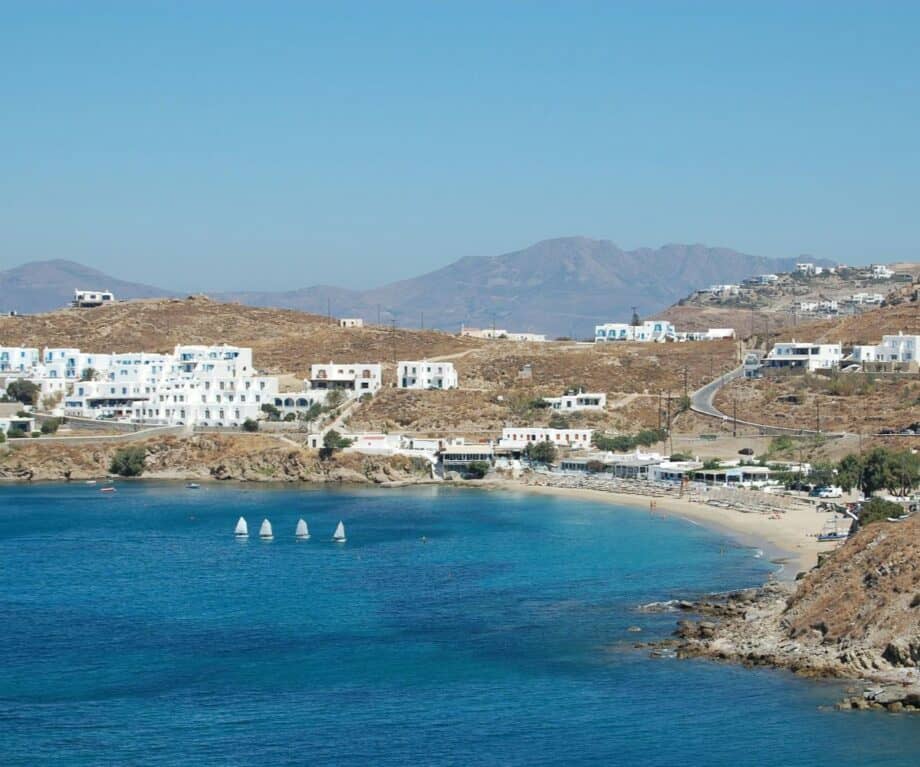
Scorpios, Nammos, the beach clubs along the southern coast, the port, the old town — these are not far from each other in kilometres. In time, in high season, at the wrong hour, they can be very far from each other indeed. A driver who knows the island knows which route works at noon and which works at midnight, knows that the road past the airport is not the answer to most problems and sometimes is the answer to all of them, knows where to wait outside a venue without creating an obstruction and without having to call for instructions on where to be.

None of this knowledge is complicated. It is specific to this island and it is acquired through time spent on it. I have been sending clients around Mykonos since before Scorpios existed in its current form, since before the beach club industry had transformed the south coast, and the transport problem has not simplified with the island’s development. It has become more acute.
The airport
Arrivals and departures set the tone for everything in between or close it out, and both deserve more attention than they typically receive from people planning a stay here.

A good arrival in Mykonos means that when the client clears the terminal, somebody knows where the bags are and the car is forty metres away. It means the drive to the villa is the beginning of the holiday rather than an extension of the journey. It means that the first impression of the island is a good one, which matters more than it might seem to, because the first impression tends to persist.

A good departure means leaving the villa without mental arithmetic about whether there is enough time, without the faint anxiety of a guest who is not entirely sure the car is coming. The flight times at Mykonos Airport in August are the kind of thing that benefits from not being tested. Getting to the airport with time to spare is not a complicated achievement. It requires a driver who knows what time to arrive, which is a function of having planned it rather than guessed it.
Excursions and what connects them
Mykonos is a useful base for the surrounding islands. Delos in the morning is an experience that repays the trouble of getting there — the archaeological site is genuinely one of the extraordinary places of the ancient world, and Rhenia, the uninhabited island just beyond it, has the kind of beaches that most visitors to Mykonos spend their entire stay not knowing exist.

These excursions involve a boat and a port at both ends. The boat has a departure time and a return time, and those times connect to the car on the island. A client who arrives back at the port at four in the afternoon should find the car there, not discover that the car was booked for three thirty and left.

The coordination of transport across a full stay in Mykonos — the airport, the daily movements, the excursions, the late evenings and the early mornings — is something Concierge Unique manages as a matter of course, because after twenty-five years of doing this we know that it is the detail clients underestimate most and the one that shapes how everything else feels.

If you are planning time in Mykonos and want the transport to be invisible, get in touch with Concierge Unique directly.

Tolis Voutsas
Tolis Voutsas is Founder and CEO at Concierge Unique. Concierge Unique is a private luxury concierge company established in Mykonos in 1999, arranging villa rentals, yacht charters, private jet transfers, destination weddings, and bespoke experiences for ultra-high-net-worth clients across Greece and internationally. If you would like to be a guest blogger on A Luxury Travel Blog in order to raise your profile, please contact us.
Did you enjoy this article?
Receive similar content direct to your inbox.
Please enable JavaScript in your browser to submit the form

Comments are closed